







Alper Aktaş
Endüstri Vadisi
- Thread Author
- #1
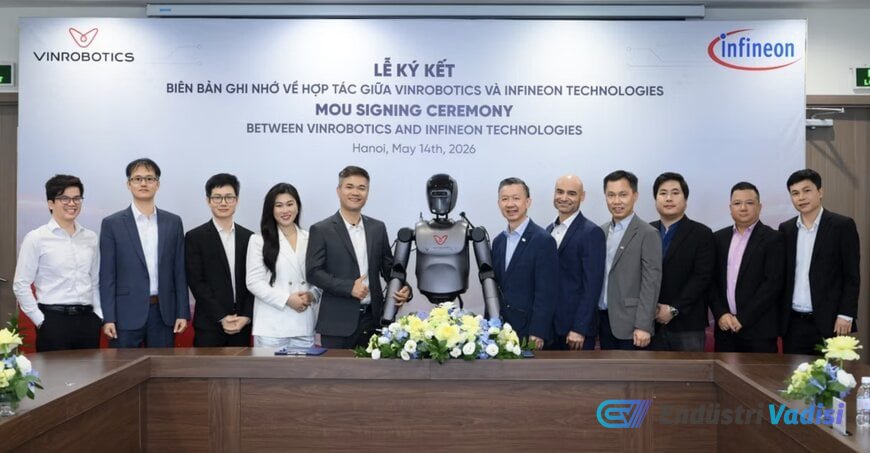
The robots of the future are at our doorstep! As humanoid robots prepare to revolutionize many fields, from industrial to home use, the technology at the heart of these complex machines is also developing at a rapid pace. This is precisely where two tech giants are joining forces: Infineon and VinRobotics!
─────────────────────────
💡 Why Humanoid Robots?
With their mobility, perception capabilities, and human-like interaction skills, humanoid robots offer potential solutions across a wide spectrum, from manufacturing to the service sector, and even in our homes. However, developing these systems requires expertise in many engineering disciplines, from sensors to processors, motor control to power management.
─────────────────────────
🤝 Foundations of the Collaboration ⚙️
Infineon Technologies and VinRobotics have signed a collaboration agreement to integrate semiconductor technologies with robotic platforms and artificial intelligence capabilities. This partnership aims to accelerate the development of humanoid robots.
[]Infineon's Contribution: A broad semiconductor portfolio including microcontrollers, sensors, power semiconductors, connectivity solutions, security, and safety components.
[]VinRobotics' Role: Robotic system development, artificial intelligence integration, and platform engineering.
─────────────────────────
🔬 Competence Center in Hanoi 🌍
To support joint development activities, a competence center will be established at VinRobotics' facility in Hanoi. This center will serve as an important base for research, system evaluation, and technical collaboration in the field of humanoid robotics and industrial automation.
─────────────────────────
🛠️ Technical Architecture and Responsibilities 📊
The collaboration focuses on integrating Infineon's semiconductor building blocks into humanoid robot architectures. Infineon technologies will support key functional areas such as environmental sensing, embedded computing, motor control, power conversion, wired and wireless communication, cybersecurity, and functional safety.
VinRobotics, in turn, will use these technologies in its robotic platforms to meet requirements such as motion control, balance, manipulation, perception, and autonomous decision-making. This will allow for the evaluation of component performance within complete robotic systems.
─────────────────────────
🚀 Development and Implementation Activities 📈
The competence center in Hanoi will support testing, prototyping, and validation activities. Engineers from both companies will evaluate semiconductor technologies, develop reference architectures, and analyze system integration approaches for future humanoid robot platforms.
This collaboration aims to accelerate development cycles by enabling semiconductor and robotics experts to work in a common technical environment. This way, integration challenges can be identified at earlier stages of the design process, and compatibility between hardware and software subsystems can be enhanced.
─────────────────────────
🏭 Industrial Applications and Expected Impact 💡
Potential application areas include manufacturing, logistics, service operations, and in-home assistance. In these environments, humanoid robots can be used for material handling, inspection, performing repetitive tasks, and human-machine interaction. Combining robotic engineering with semiconductor expertise can support improvements in energy efficiency, system safety, motion control precision, and platform scalability. This collaboration also reflects the increasing investment in digital infrastructure and advanced robotics development in Southeast Asia.
This partnership stands out as a significant step in shaping the future of humanoid robots and opens the door to exciting developments in the world of technology.