






Erkan Teskancan
Kurumsal
- Thread Author
- #1
## Robotic Machining Cell for Composite Aerospace Structures
At BIEMH 2026, IDEKO presented a significant demonstration to advance industrial automation in the production of composite wing components through high-precision robotic machining and inspection processes.
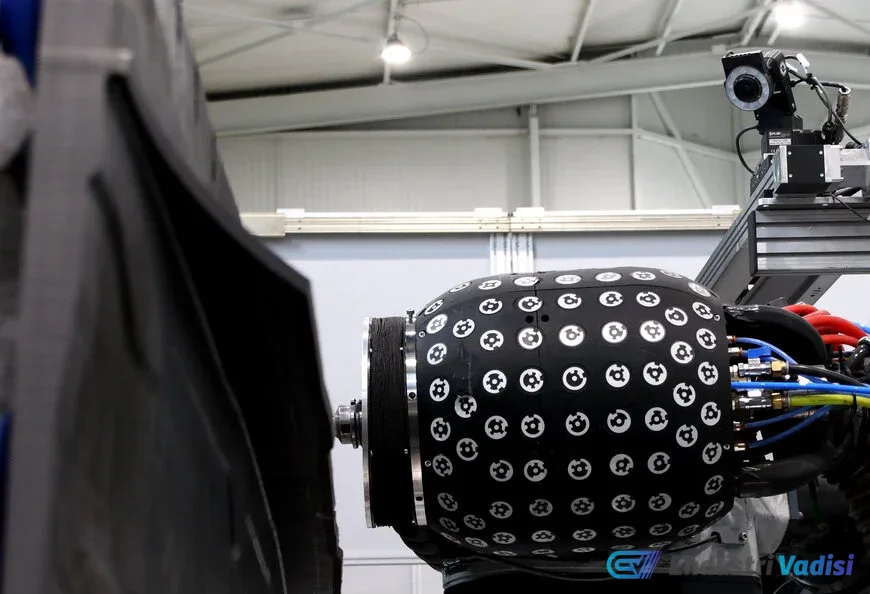
Aerospace structures made from composite materials, such as carbon fiber reinforced polymers, require tight tolerances during drilling and milling operations. To overcome the limitations in positional accuracy and process stability typically seen in standard industrial robots, IDEKO developed and successfully tested a high-precision robotic cell that integrates both machining and inspection processes.
### Collaboration and Objective
As a member of the Basque Research and Technology Alliance, IDEKO aims to transfer advanced manufacturing technologies from R&D environments to industrial applications in collaboration with aerospace manufacturers. This partnership focuses particularly on machining large composite parts like wing structures, where elements such as dimensional tolerances, hole quality, and surface integrity directly impact assembly accuracy and structural durability.
### Technical Solution and Features
- An intelligent robotic cell was designed, combining milling, drilling, deburring, and in-process inspection.
- The robot's end effector is continuously monitored in large volumes using photogrammetry and computer vision techniques.
- Real-time position corrections are made with predictive metrology models.
- Automatic camera positioning is provided throughout the machining path.
- Automatic referencing is performed after the part is clamped.
- Adaptive tool paths are generated based on measured geometries.
This setup minimizes positioning errors and increases consistency by reducing the need for recalibration. Additionally, vibrations and process parameters are monitored with advanced sensors, allowing early detection of anomalies that could affect surface quality and hole integrity.
Issues specific to composites, such as delamination and dust emission, are effectively managed with optimized machining strategies and integrated carbon fiber dust extraction systems.
IDEKO is responsible for the system architecture, metrology integration, fixture design, and commissioning processes, while industrial partners provide suitable aerospace structural parts, operational requirements, and testing conditions.
### Application and Integration
The demonstrator presented at BIEMH 2026 is used on a typical aircraft wing component. The cell design stands out with the following features:
- Access of the robot and machining head to all functional areas
- Control of gravity-induced deformation
- Compatibility with digital reference systems
- Positional repeatability under machining loads
Special fixtures enable automatic referencing and geometry-based path correction while ensuring stable and secure clamping. The system is integrated into existing digital infrastructure, allowing for data collection for process optimization and traceability.
### Expected Impacts
This solution is primarily aimed at precise drilling and cutting operations and production line dimensional validation in the manufacturing of large composite aerospace structures. Rather than replacing traditional machine tools, it extends industrial automation to applications requiring high volumetric accuracy.
Thanks to real-time metrology, adaptive control, and optimized fixture design, process stability is increased, manual interventions are reduced, surface quality is improved, and safer processing of carbon fiber materials is ensured.