








Erkan Teskancan
Kurumsal
- Thread Author
- #1
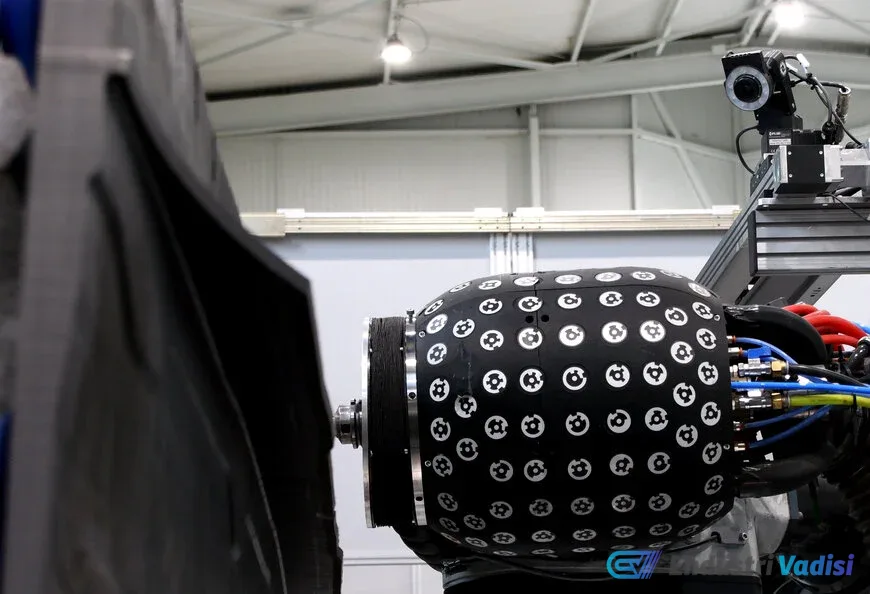
## High-Precision Robotic Machining Cell for Composite Aerospace Structures
IDEKO and aerospace manufacturers showcased high-precision robotic machining and inspection of composite wing components at the BIEMH 2026 exhibition. This work aims to contribute to the advancement of industrial automation in aerospace structures.
Composite aerospace structures made from carbon fiber reinforced polymers require tight tolerances during drilling and milling operations. IDEKO has developed and validated a high-precision robotic cell that integrates machining and inspection to overcome the typical positioning accuracy and process stability limitations of standard industrial robots.
### Scope of Collaboration
IDEKO, as a member of the Basque Research and Technology Alliance, collaborates with aerospace manufacturers. This collaboration focuses on applying advanced manufacturing technologies, resulting from research and development efforts, to the fabrication of large composite components, particularly wing structures. Dimensional tolerances, hole quality, and surface integrity directly impact assembly precision and structural performance.
While traditional articulated robots offer flexibility and a large working envelope, they lack the structural rigidity and volumetric accuracy of precision machine tools. For composite materials, there are additional challenges such as the risk of delamination, fiber pull-out, and dust emissions generated during drilling and cutting. These issues require expertise in robotics, metrology, fixture design, and process engineering.
### Technical Solution and Responsibilities
IDEKO designed an intelligent robotic cell that combines milling, drilling, deburring, and in-process inspection. The system includes the following features:
- Photogrammetry and computer vision technologies for continuous tracking of the robot's end effector in large volumes.
- Predictive metrological models for real-time position correction.
- Automatic camera positioning along the process path.
- Automatic referencing when the part is fixtured.
- Adaptive tool path generation based on measured geometry.
This architecture reduces positioning errors during machining while eliminating the need for extensive manual calibration and increasing process repeatability. Furthermore, advanced sensor systems monitor vibrations and process parameters, detecting irregularities that could affect surface quality and hole integrity at an early stage.
To prevent defects specific to composite materials, machining strategies were optimized to minimize delamination. Integrated extraction systems collect carbon fiber dust at the source, helping to meet occupational safety and exposure standards.
IDEKO is responsible for the system architecture, metrology integration, fixture design, and commissioning processes. Industrial partners provide representative aerospace structural components, operational requirements, and validation under production-like conditions.
### Setup and Integration
The demonstrator presented at BIEMH 2026 in Bilbao is applied to an aircraft wing component. Factors such as the robot's and machining head's access to all functional areas, control of deformations caused by gravity, compatibility with digital reference systems, and position repeatability under machining loads were considered.
Special fixtures stabilize part clamping while enabling automatic referencing and geometry-based path corrections. The system integrates with existing digital infrastructure, allowing for data collection for process optimization and traceability.
### Applications and Expected Impact
The solution is specifically intended for use in the manufacturing of aerospace structures, particularly where large composite components are produced. It is suitable for applications such as precise drilling operations, cutting operations, and in-line dimensional verification.
This approach, rather than replacing machine tools, extends industrial automation to applications requiring higher volumetric accuracy. Through the combination of real-time metrology, adaptive control, and optimized fixtures, process stability is increased, manual intervention is reduced, surface quality is improved, and safer processing of carbon fiber materials is ensured.
www.ideko.es























