





- Thread Author
- #1
With the support of artificial intelligence, machine learning, and the KUKA KR10 industrial robot, the EU-backed Recirculate project has developed a dismantling system for recycling electric vehicle batteries.
Recirculate Project: An Innovative Approach to Electric Vehicle Battery Recycling
The Recirculate project, funded by the European Union, has aimed to make electric vehicle (EV) battery recycling smarter over the past 18 months. The most challenging stage of the recycling process is physically dismantling battery packs to separate modules and cells. To reduce the time and cost of this process, Recirculate has programmed a KUKA KR10 industrial robot and specialized machine learning (ML) and artificial intelligence (AI) algorithms to identify key components.
The recycling process is complex due to the structural challenges of EV batteries. Battery recycling can often be challenging compared to sending them to landfills, which is usually more cost-effective. However, recycling these batteries is critically important for both environmental protection and the reuse of valuable materials.
The Recirculate project has developed a system that facilitates the dismantling of EV batteries with the aim of creating a sustainable circular economy. This system aims to both reduce costs and minimize environmental impact.
uses a KUKA KR10 industrial robot equipped with tools specially made to disassemble EV battery packs. Image used courtesy of KUKA
Recirculate’s robotic cell uses a KUKA KR10 industrial robot equipped with tools specially made to disassemble EV battery packs. Image used courtesy of KUKA
Dismantling EV Batteries
One of the most time consuming and labor intensive steps in battery recycling for EVs is disassembly. Each of these customized battery packs has dozens of screws, wire harnesses, connectors, washers, and other hardware, each of which must be painstakingly removed.
For battery recycling to be possible, batteries must be stripped down into individual cells. The disassembly first removes the lid, then separates the pack into modules, and then the modules into individual battery cells. The lid itself may contain as many as 50 individual screws to remove before any other disassembly can occur.
In order to simplify this process, the Recirculate team has developed a robotic cell that disassembles battery packs. At the heart of this cell is a KUKA KR10 industrial robot, equipped with screwdrivers and vacuum grippers. Each tool has a depth camera installed so that the robot can perform operations in x, y and z coordinate space.
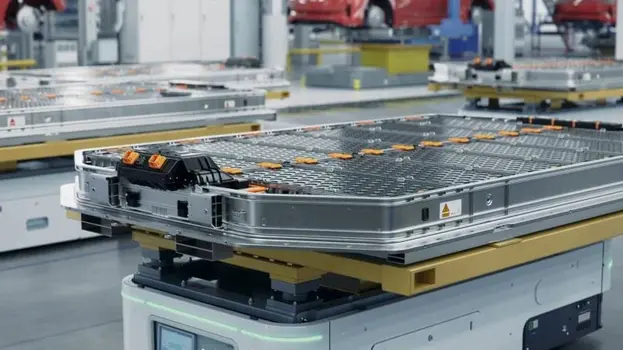
With the use of machine learning models, Recirculate’s system maps out battery parts for robotic disassembly
With the use of machine learning models, Recirculate’s system maps out battery parts for robotic disassembly. Image used courtesy of Adobe Stock
With the use of machine learning models, Recirculate’s system maps out battery parts for robotic disassembly. Image used courtesy of Adobe Stock
Leveraging ML/AI
Physical battery disassembly via a robot is possible, and has been for a few decades. However, the complicated bolt patterns and variations in construction between EV battery manufacturers require extensive programming. So far, this has been cost-pr
Circular Battery Economy: The Recirculate Project
Recirculate uses the depth camera on the robot's tool and a machine learning (ML) system to identify various screw configurations and guide the tools to the appropriate locations. ML algorithms enable the robot to be programmed by comparing photos with libraries of known battery packs. The algorithm for damaged or new models helps recyclers create a new library. This system is the result of 18 months of work and many man-hours.
Electric vehicles (EVs) offer the potential to reduce pollution and solve other problems. However, the disposal of large and potentially toxic batteries is among the unforeseen consequences of the widespread adoption of these vehicles. Projects like Recirculate represent the first step in reducing this waste stream, which is predicted to increase rapidly in the coming decades.
Recirculate Project: An Innovative Approach to Electric Vehicle Battery Recycling
The Recirculate project, funded by the European Union, has aimed to make electric vehicle (EV) battery recycling smarter over the past 18 months. The most challenging stage of the recycling process is physically dismantling battery packs to separate modules and cells. To reduce the time and cost of this process, Recirculate has programmed a KUKA KR10 industrial robot and specialized machine learning (ML) and artificial intelligence (AI) algorithms to identify key components.
The recycling process is complex due to the structural challenges of EV batteries. Battery recycling can often be challenging compared to sending them to landfills, which is usually more cost-effective. However, recycling these batteries is critically important for both environmental protection and the reuse of valuable materials.
The Recirculate project has developed a system that facilitates the dismantling of EV batteries with the aim of creating a sustainable circular economy. This system aims to both reduce costs and minimize environmental impact.
uses a KUKA KR10 industrial robot equipped with tools specially made to disassemble EV battery packs. Image used courtesy of KUKA
Recirculate’s robotic cell uses a KUKA KR10 industrial robot equipped with tools specially made to disassemble EV battery packs. Image used courtesy of KUKA
Dismantling EV Batteries
One of the most time consuming and labor intensive steps in battery recycling for EVs is disassembly. Each of these customized battery packs has dozens of screws, wire harnesses, connectors, washers, and other hardware, each of which must be painstakingly removed.
For battery recycling to be possible, batteries must be stripped down into individual cells. The disassembly first removes the lid, then separates the pack into modules, and then the modules into individual battery cells. The lid itself may contain as many as 50 individual screws to remove before any other disassembly can occur.
In order to simplify this process, the Recirculate team has developed a robotic cell that disassembles battery packs. At the heart of this cell is a KUKA KR10 industrial robot, equipped with screwdrivers and vacuum grippers. Each tool has a depth camera installed so that the robot can perform operations in x, y and z coordinate space.
With the use of machine learning models, Recirculate’s system maps out battery parts for robotic disassembly
With the use of machine learning models, Recirculate’s system maps out battery parts for robotic disassembly. Image used courtesy of Adobe Stock
With the use of machine learning models, Recirculate’s system maps out battery parts for robotic disassembly. Image used courtesy of Adobe Stock
Leveraging ML/AI
Physical battery disassembly via a robot is possible, and has been for a few decades. However, the complicated bolt patterns and variations in construction between EV battery manufacturers require extensive programming. So far, this has been cost-pr
Circular Battery Economy: The Recirculate Project
Recirculate uses the depth camera on the robot's tool and a machine learning (ML) system to identify various screw configurations and guide the tools to the appropriate locations. ML algorithms enable the robot to be programmed by comparing photos with libraries of known battery packs. The algorithm for damaged or new models helps recyclers create a new library. This system is the result of 18 months of work and many man-hours.
Electric vehicles (EVs) offer the potential to reduce pollution and solve other problems. However, the disposal of large and potentially toxic batteries is among the unforeseen consequences of the widespread adoption of these vehicles. Projects like Recirculate represent the first step in reducing this waste stream, which is predicted to increase rapidly in the coming decades.