






Cengiz Özemli
Akademisyen
- Thread Author
- #1
## Physical Artificial Intelligence in Industry: Universal Robots' Four Predictions
Physical artificial intelligence (AI), as technology applied to real-world devices like robots, is expected to make a significant impact in the next few years. Universal Robots shares its four predictions regarding key developments in this field.
The robotics industry is evolving faster than ever before, and the signals of the future are already becoming clear. Anders Beck, Vice President of AI Robotics Products at Universal Robots, shares four key developments that will play a significant role in physical artificial intelligence in the coming years.
### Physical Artificial Intelligence and the Robots of the Future
Today, robots operate as reactive devices, responding to inputs and adapting in real-time. However, tomorrow's robots will make decisions by anticipating their movements. For example, they will be able to predict the effect of a path adjustment and simulate many "what if" scenarios within milliseconds. This is not science fiction; it's a natural evolution in derivative calculations and system behavior prediction.
### Mathematical Models for High Efficiency
Beck states that convolutional intelligence will define the next generation of automation, emphasizing the importance of when and by whom this change will be led. New approaches in robotics allow for scenario planning by representing various distributions in AI models with concepts like dual numbers and jets. This enables the controller to offer many pre-predicted backup strategies, increasing the efficiency of the operation.
### Example Scenarios in Industrial Robots
Beck emphasizes that calculating many backup plans in advance will greatly increase robotic efficiency, especially in variable processes like surface treatment and in assembly operations. These methods offer significant advantages compared to neural networks, which operate relatively slowly.
### The Rise of Imitation Learning
Future robots will form teams that adapt by learning from each other and from humans. This new generation will focus not on replication, but on following human intent. Industrial robot suppliers have already established the basic infrastructure, such as fleet management and synchronized movement in multi-arm systems; however, true peer-to-peer learning and self-organization will soon become widespread.
### Safety and Supervision in Imitation Learning
Beck emphasizes that supervision methodologies are critical in AI learning, stating that the system will first be modeled with pre-training and then continuously improved with real-world data. This approach prevents the repetition of undesirable behaviors.
### Application-Specific AI Usage
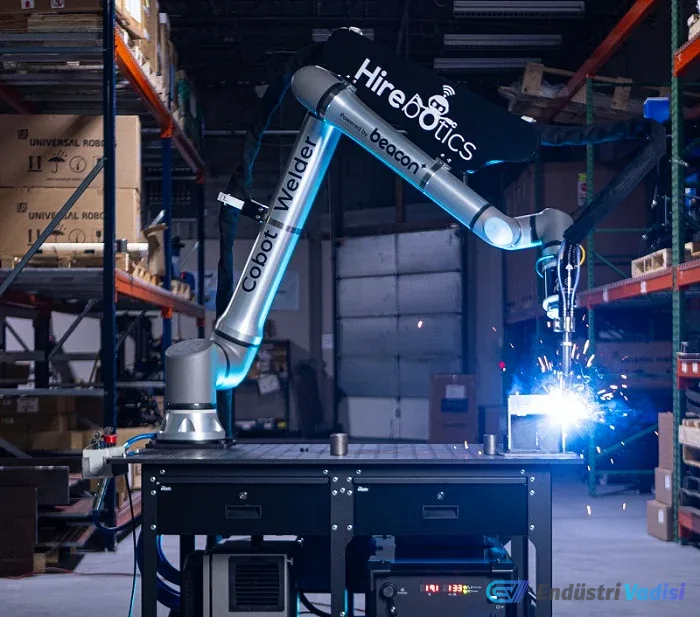
Universal Robots predicts that AI applications tailored to specific processes such as welding, sanding, inspection, and assembly will become widespread, rather than general AI systems. For example, AI-powered seam tracking and parameter optimization in welding are already transforming the industry.
### Evolution of Competencies
Beck states that process-based competencies will become more important than specialized expertise in robotics. While human skills are still needed in welding applications, this skill set will diminish with AI-powered tools. This alleviates the need for robot programming expertise.
### Value Creation Through Data
It is predicted that in the future, robot manufacturers, with customer consent, will securely share anonymized performance data and provide datasets to AI developers for smarter applications. This will enable AI to be used more effectively in areas such as fault prediction, quality control, and adaptive control.
### The Future Robotic Journey
The central evaluation of rich datasets collected from robots, combined with advanced techniques and intelligent applications, will bring significant advancements in productivity and operational efficiency. Data-driven strategies will increase productivity per robot hour, accelerate setup and reconfiguration, reduce failures, and enable real-time improvement.
Universal Robots' predictions point to significant developments that will bring new opportunities and transformations in the physical applications of industrial artificial intelligence.