








Cengiz Özemli
Akademisyen
- Thread Author
- #1
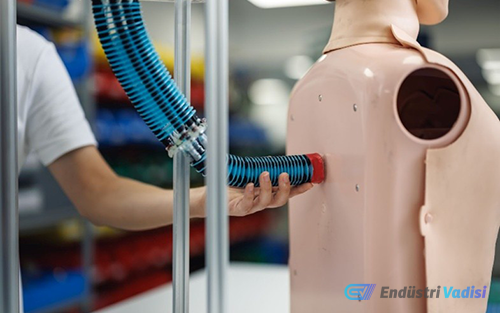
A new AI control system has been developed that enables soft robotic arms to learn a wide repertoire of movements at once and adapt instantly to changing conditions. This system allows robots to move flexibly and adaptively without the need for retraining.
Developed through a collaboration between the Singapore-based SMART Mens, Manus & Machina (M3S) research group and the National University of Singapore (NUS), Massachusetts Institute of Technology (MIT), and Nanyang Technological University (NTU), this AI-based control system enables soft robotic arms to simultaneously learn behaviors acquired in different tasks and rapidly adapt to new situations. This development enhances the human-like compliance capabilities of soft robots, offering the potential for safer and more versatile use in fields such as assistive robotics, rehabilitation, and medical robotics.
Soft robots move using flexible materials and actuators that act as artificial muscles, rather than rigid motors. This design makes them ideal for delicate and compliant tasks, but challenging to control, as their shapes can change unpredictably. Even small changes in real-world conditions can disrupt the robots' movements.
Until now, soft robots typically achieved only one or two of the following capabilities: utilizing learned information across different tasks, rapid adaptation, or ensuring stability during movement. Without all three of these features combined, the use of robots in real-world applications remained limited.
### AI Control System
The new system, inspired by the principle of artificial synaptic connections, operates two types of "synapses" in parallel. "Structural synapses" are trained offline on basic movements, while "plastic synapses" fine-tune online as the robot operates. This structure optimizes the robot's movement according to instantaneous conditions while ensuring stability in movements.
### Technical Specifications
- Prior knowledge based on various fundamental movements is learned offline
- Instantaneous response through online adaptation
- Built-in stability criterion ensuring safety and stability in movements
- Supports multiple task types: path following, object placement, whole-body shape control
- Cross-compatibility across different soft arm platforms
- Tests: cable-driven soft arm and shape memory alloy actuated soft arm
- 44–55% error reduction against heavy external disturbances
- Over 92% shape accuracy despite load changes, air currents, and actuator failures
- Stable performance even if half of the actuators fail
### Future and Industrial Applications
This technology has the potential to reduce costs and operational losses by decreasing the need for continuous programming in manufacturing, logistics, healthcare, and rehabilitation. Patient support and rehabilitation devices can automatically adapt to the patient's condition, while medical soft robots can respond more sensitively to individual needs.
Researchers plan to integrate the system into other robotic systems that can operate in fast and complex environments. This will open up broad application possibilities in fields such as assistive robotics, medical devices, and industrial soft manipulators.
This work was carried out in collaboration between SMART and NUS, with support from the Singapore National Research Foundation's CREATE program.























