

Cengiz Özemli
Akademisyen
- Thread Author
- #1
## Natural Language Control in Industrial Motion Systems
Beckhoff introduces the integration of natural language control into industrial motion systems, enabling language models to coordinate robot movement and perform diagnostics in production environments in conjunction with deterministic control platforms.
While traditional industrial control systems rely on predefined logic and engineering tools, Beckhoff's approach links large language models with real-time automation platforms, allowing machines to understand operator intent rather than fixed commands. This physical-AI control architecture, presented at Hannover Messe 2026, enables a direct connection between the LLM and motion control hardware.
### Language Model and PLC Logic in Motion Control
In classical automation, IT-level intelligence is separate from OT-level deterministic control. PLCs execute pre-validated sequences, while optimization and analysis are mostly performed externally. Beckhoff's new architecture unifies these layers via standard interfaces, allowing the AI model to generate instructions that the real-time controller will execute safely and deterministically.
This system is suitable for production cells, robotics, assembly, and flexible material handling systems that require frequent reconfiguration. Operators specify their tasks in natural language instead of editing control code; the control system interprets the intent, translates it into motion instructions, and executes them within industrial timing constraints.
### Coordinated Movement with Voice Commands
At the Hannover Messe press preview, Beckhoff presented a demo cell combining the XPlanar horizontal motor transport system, TwinCAT CoAgent AI runtime, and a voice interface. Motion instructions based on spoken language were transmitted to the floating movers, automatically initiating the subsequent sequence of movements. The controller converted the semantic input into deterministic path traces while maintaining control loop requirements.
This demo showed that language-based control can trigger multi-axis coordinated movement without manual programming, allowing even non-expert users to manage automation processes.
### Industrial Robotics and Artificial Intelligence Integration
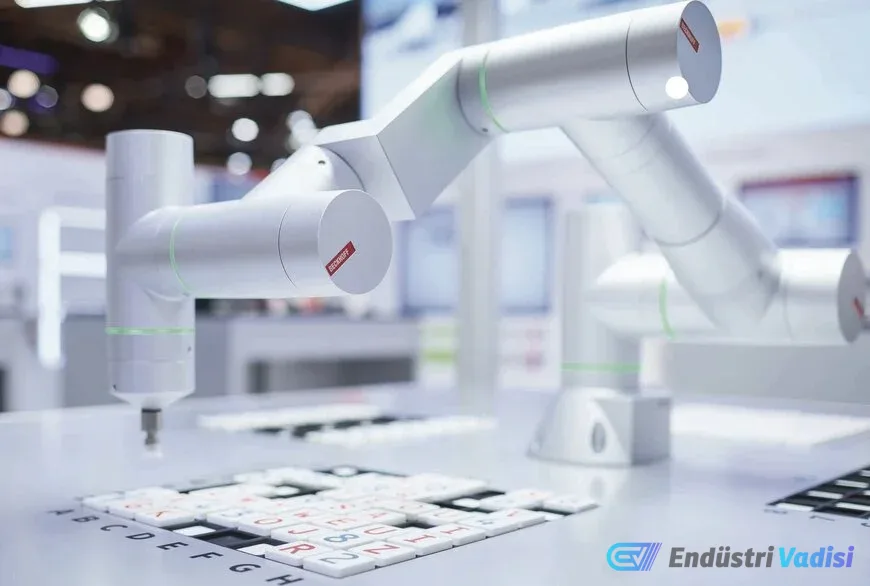
At Hannover Messe 2026, this scenario will be extended to the ATRO modular industrial robot system, operating with TwinCAT CoAgent. The language model will be connected to the machine control stack via the Model Context Protocol (MCP).
The system will interpret voice commands to generate path planning parameters and initiate diagnostic processes. At the exhibition, the robot will play chess with visitors, demonstrating coordinated functionality through real-time sensing, decision-making, and motion control.
### Engineering and Runtime Definition
Beckhoff provides the runtime interface between language models and control systems via TwinCAT CoAgent, while supporting model creation and application with TwinCAT Machine Learning Creator. These tools enable automated configuration and fault analysis during both engineering and operational phases.
Instead of altering PLC logic, the system adds a supervisory layer that generates structural instructions within the deterministic control boundaries.
### Implications for Automation Architecture
Artificial intelligence is integrated into the control framework, moving beyond being an external analysis tool. While the language model interprets context, the deterministic controller maintains timing and safety limits. This separation allows for adaptive behavior while preserving industrial reliability.
In production environments with frequent changes in product variants and workflows, natural language interaction shortens the commissioning process, while standard protocols like MCP ensure compatibility with existing automation applications in robotics and production systems.