







- Thread Author
- #1
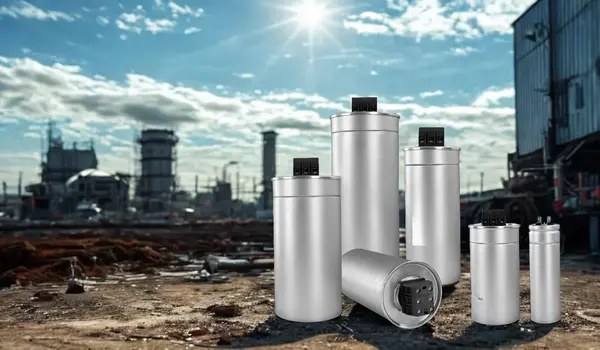
Before delving into the topic, I find it beneficial to define what a capacitor is.
A capacitor temporarily stores electrical charge and energy within an electric field. It achieves this storage using two conductive plates and an insulating (dielectric) material placed between them. In terms of its application, it can be described as a passive electronic circuit component.
While capacitors act as insulators in DC circuits, they exhibit frequency-dependent reactance in AC circuits. Due to these properties, capacitors are used for power factor correction and motor starting.
How Does a Capacitor Work?
Capacitors operate in four stages in terms of their working principle.
Filtering: To reduce ripple in power supplies.
Bypass/Decoupling: Placed near integrated circuits to allow noise to be absorbed by the ground.
Timing: To create delay and time constants using RC circuits.
Power Electronics: To act as an energy buffer in inverters, drivers, and motor circuits within the system.
Capacitor Formula
When we examine it fundamentally;
Capacitance (Farad) = Charge stored in capacitor (Coulomb) / Applied Voltage (Volt)
Formula; C = Q / V
Let's look at the formula for a plate structure;
C (Coulomb) = ε (Dielectric constant) . A (plate area) / d (Distance between plates)
Formula; C = ε . A / d
Reactance is; Xc (Capacitive Reactance) = 1 / (2π f (Frequency) C (capacitance)
Formula; Xc = 1 / (2π f C)
Connections; If parallel, C total = C1+C2+…
Series connection = 1/C total = 1/C1 + 1/C2+
These formulas help you select the right product by calculating based on the product and connection type.
How to Perform Correct Capacitor Measurement and Fault Detection?
In some cases, you may need to check if the capacitor is performing its function correctly. For this, you can take measurements by following the steps below.
Safety; Completely disconnect the circuit and discharge the energy in the capacitor with an appropriate resistor.
Multimeter Selection; Use an LCR meter or a multimeter capable of capacitance measurement.
Connection; Remove the capacitor from the circuit and touch it with the probes. If the displayed value you get is outside the tolerance when compared to the label value on the product, there may be a fault.
ESR Check (if necessary); Especially in electrolytics, if the ESR value is high, the component may not function even if the capacitance appears correct. It would be appropriate to check this with an ESR meter.
Leakage Test; For insulation or leakage tests in high-voltage areas, appropriate test equipment should be used. For example, a Megger or an insulation tester.
To summarize, capacitors are devices that store energy, suppress noise, and provide timing and signal shaping. Knowing the correct capacitor formulas and measurements is the first key to building reliable and efficient systems.