








- Thread Author
- #1
RoboBallet from Google DeepMind and Intrinsic uses AI to generate collision-free robot motion plans in seconds, replacing weeks of manual coding.
RoboBallet: Revolutionizing Robot Programming with AI
RoboBallet, an innovation developed by Google DeepMind Robotics, Intrinsic, and University College London, redefines robot programming with artificial intelligence. Instead of weeks of manual coding, this system generates collision-free multi-robot motion plans in seconds by combining graph neural networks and reinforcement learning. Robots move in harmony like dancers on a stage and can efficiently scale from four arms to eight. With potential applications in automotive, electronics, and more, RoboBallet shifts the role of engineers from coding to defining higher-level tasks and goals.
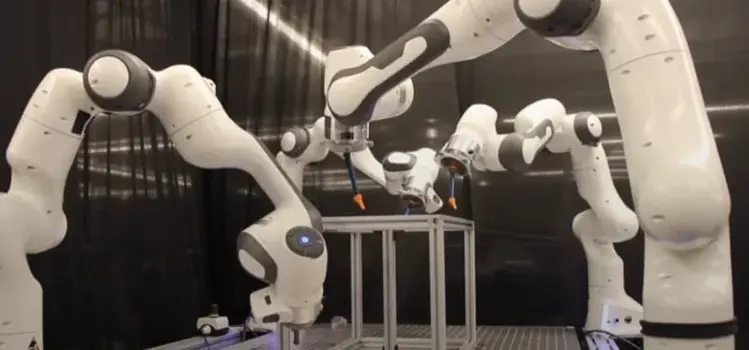
RoboBallet uses AI to coordinate multiple robots, generating collision-free motion plans in seconds. Image courtesy of Intrinsic.
An Innovative Approach with RoboBallet
The new project from Google DeepMind Robotics, Intrinsic, and University College London offers a fresh perspective on robot programming. The name RoboBallet symbolizes robots moving in harmony rather than as rigid machines. Using artificial intelligence, the platform can generate collision-free motion plans for multiple robots in mere seconds, transforming the weeks-long process of human programming into fluid automation.
Why is Multi-Robot Planning Difficult?
Even programming just two robots in the same workspace is challenging, and adding several more robots complicates matters further. With obstacles, changing layouts, and eight robot arms working side-by-side, the number of possible paths reaches billions. Traditional algorithms struggle, forcing human experts to manage the process with rule changes and endless test runs. Moreover, when the factory layout changes or a new part is added, all that hard work goes to waste, and the process starts over.
RoboBallet's Success
RoboBallet's success lies in combining two AI technologies. First, a graph neural network maps the workspace as a network of nodes and connections, where robots, obstacles, and tasks are all on the same graph. Then, reinforcement learning enables the system to find fast and safe solutions through trial and error. Trained on millions of simulated scenarios, RoboBallet can step into an entirely new setup, read CAD files, and develop efficient motion paths in seconds. No manual coding, teaching devices, or annotated data.
RoboBallet: Revolutionizing Robot Programming with AI
RoboBallet, an innovation developed by Google DeepMind Robotics, Intrinsic, and University College London, redefines robot programming with artificial intelligence. Instead of weeks of manual coding, this system generates collision-free multi-robot motion plans in seconds by combining graph neural networks and reinforcement learning. Robots move in harmony like dancers on a stage and can efficiently scale from four arms to eight. With potential applications in automotive, electronics, and more, RoboBallet shifts the role of engineers from coding to defining higher-level tasks and goals.
RoboBallet uses AI to coordinate multiple robots, generating collision-free motion plans in seconds. Image courtesy of Intrinsic.
An Innovative Approach with RoboBallet
The new project from Google DeepMind Robotics, Intrinsic, and University College London offers a fresh perspective on robot programming. The name RoboBallet symbolizes robots moving in harmony rather than as rigid machines. Using artificial intelligence, the platform can generate collision-free motion plans for multiple robots in mere seconds, transforming the weeks-long process of human programming into fluid automation.
Why is Multi-Robot Planning Difficult?
Even programming just two robots in the same workspace is challenging, and adding several more robots complicates matters further. With obstacles, changing layouts, and eight robot arms working side-by-side, the number of possible paths reaches billions. Traditional algorithms struggle, forcing human experts to manage the process with rule changes and endless test runs. Moreover, when the factory layout changes or a new part is added, all that hard work goes to waste, and the process starts over.
RoboBallet's Success
RoboBallet's success lies in combining two AI technologies. First, a graph neural network maps the workspace as a network of nodes and connections, where robots, obstacles, and tasks are all on the same graph. Then, reinforcement learning enables the system to find fast and safe solutions through trial and error. Trained on millions of simulated scenarios, RoboBallet can step into an entirely new setup, read CAD files, and develop efficient motion paths in seconds. No manual coding, teaching devices, or annotated data.























