





- Thread Author
- #1
The Future of Artificial Intelligence and Automation in Industry: Opportunities and Risks
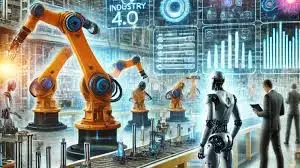
Artificial intelligence, which simplifies many of our tasks today, significantly impacts individuals' daily lives. While some argue that AI is beneficial, for others, it leads to negative outcomes. Among the prominent and most utilized sectors for artificial intelligence are automotive, health and pharmaceutical, electronics, finance, agriculture, and food, offering numerous options. So, from the perspective of industrial automation, is AI a gain or a loss? Let's examine these. The adoption rate of artificial intelligence in industry is projected to be 15% as of 2023, with an increase of 4% in 2024 and 74% in 2025, exceeding the 74% level in 2026. However, the extent to which this increase will have positive or negative consequences for society and industry is a subject of debate.
Opportunities of Artificial Intelligence and Automation in Industry
Thanks to the opportunities arising from the increase of artificial intelligence and automation in industry, product quality has improved, and errors have decreased. The reduction in errors has also led to savings in production costs. While eliminating time constraints, there has also been an increase in the innovation capacity of products. Standards for new product design have risen, and existing products have undergone optimization. Predicting potential errors in advance presents a significant opportunity for reverse logistics.
Risks of Artificial Intelligence and Automation in Industry
Among the risks and disadvantages of artificial intelligence and automation in industry are the decreased need for human labor, the weakening of manual skills and coordination abilities, and the emergence of faulty algorithms causing critical problems. Data security and privacy concerns also raise doubts about the use of artificial intelligence in industry.
Although the need for human resources in some professions may decrease, new employment opportunities are emerging in fields such as Software Engineering, Electrical-Electronics Engineering, Artificial Intelligence and Data Science, and Robotics and Automation Technologies. Regardless of the extent of artificial intelligence, systems should not be put into service without human supervision.
In conclusion, it is important to consider that artificial intelligence and automation can create opportunities in industry, but they also bring certain risks. To mitigate these risks, it is crucial not to completely eliminate human labor and to ensure that supervision and security processes are carried out by humans. Once this balance is achieved, the risks can be eliminated, leading to increased production efficiency and confirming that artificial intelligence supports humans.
Artificial intelligence, which simplifies many of our tasks today, significantly impacts individuals' daily lives. While some argue that AI is beneficial, for others, it leads to negative outcomes. Among the prominent and most utilized sectors for artificial intelligence are automotive, health and pharmaceutical, electronics, finance, agriculture, and food, offering numerous options. So, from the perspective of industrial automation, is AI a gain or a loss? Let's examine these. The adoption rate of artificial intelligence in industry is projected to be 15% as of 2023, with an increase of 4% in 2024 and 74% in 2025, exceeding the 74% level in 2026. However, the extent to which this increase will have positive or negative consequences for society and industry is a subject of debate.
Opportunities of Artificial Intelligence and Automation in Industry
Thanks to the opportunities arising from the increase of artificial intelligence and automation in industry, product quality has improved, and errors have decreased. The reduction in errors has also led to savings in production costs. While eliminating time constraints, there has also been an increase in the innovation capacity of products. Standards for new product design have risen, and existing products have undergone optimization. Predicting potential errors in advance presents a significant opportunity for reverse logistics.
Risks of Artificial Intelligence and Automation in Industry
Among the risks and disadvantages of artificial intelligence and automation in industry are the decreased need for human labor, the weakening of manual skills and coordination abilities, and the emergence of faulty algorithms causing critical problems. Data security and privacy concerns also raise doubts about the use of artificial intelligence in industry.
Although the need for human resources in some professions may decrease, new employment opportunities are emerging in fields such as Software Engineering, Electrical-Electronics Engineering, Artificial Intelligence and Data Science, and Robotics and Automation Technologies. Regardless of the extent of artificial intelligence, systems should not be put into service without human supervision.
In conclusion, it is important to consider that artificial intelligence and automation can create opportunities in industry, but they also bring certain risks. To mitigate these risks, it is crucial not to completely eliminate human labor and to ensure that supervision and security processes are carried out by humans. Once this balance is achieved, the risks can be eliminated, leading to increased production efficiency and confirming that artificial intelligence supports humans.