




Ahmet Ö.
Kurumsal
- Thread Author
- #1
## Analog vs. Fieldbus Systems: Comparisons and Advantages
Learn about electrical signal systems for process control. What are the advantages of analog systems compared to advanced modern fieldbus protocols?
Early manufacturing plants did not have automatic control systems; all processes were started and stopped by human intervention.
Electronic instrumentation eventually replaced mechanical and pneumatic systems, and common signal standards such as 4-20 mA current loops or 0-10/0-5 volt DC emerged.
This article will examine the most commonly used signal ranges in industrial applications, their areas of use, and their strengths and weaknesses.
### Analog Signal Systems
The traditional 4-20 mA current loop is a widely used system in process control. A 4 mA signal indicates the minimum of the actual process value (e.g., current, voltage, flow, speed, etc.), while 20 mA represents the maximum value. The designation of 4 mA as a live zero allows for easy detection of open-circuit faults (e.g., a broken wire) because in such a case, the signal drops to 0 mA.
A 0-10 V DC signal is acceptable in many applications; however, according to Ohm's law, voltage drop occurs over long distances, leading to signal loss. Therefore, if the transmitter is near the process and the control device is far away, the mA signal system is more advantageous.
According to Ohm's Law, voltage drop (V) is equal to the product of current (I) and resistance (R). As the wire lengthens, resistance increases, causing the voltage signal to suffer more loss. Voltage signals are preferred for local short distances.
Although many microcontrollers and digital I/O cards recently require 1-5 V DC signals, the 4-20 mA signal is preferred in industry. Receivers like RTU/PLC use a 250 Ω resistor to convert the 4-20 mA signal to 1-5 V.
### Fieldbus Systems
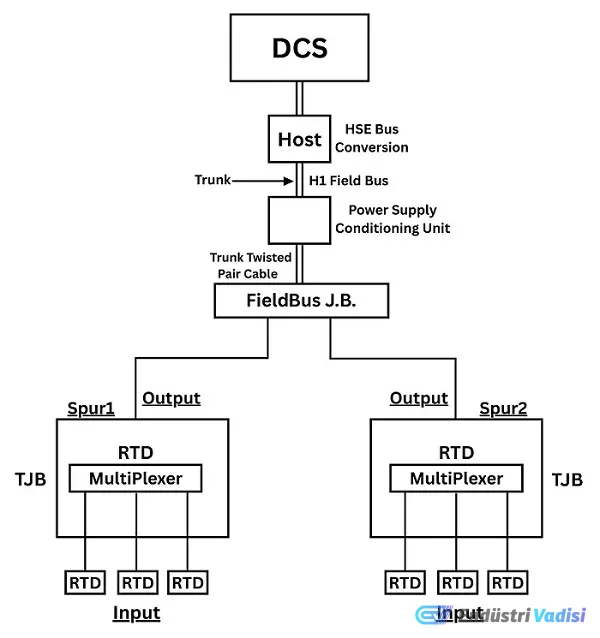
Fieldbus is a communication protocol that enables digital data exchange between a sender and a receiver. Foundation Fieldbus is a standardized digital protocol in process control that allows many devices to communicate on the same digital network.
The terms sender and receiver apply to control units such as PLCs, IEDs, and RTUs. Foundation Fieldbus transmits not only telemetry but also diagnostic and device health data. Service engineers can easily adjust device settings remotely for maintenance and troubleshooting.
Common fieldbus protocols include HART, PROFIBUS, and Modbus. Compared to the traditional 4-20 mA system, it requires less cabling. Instead of a separate cable for each device, devices are connected to the network in a bus or star topology, and a single cable is routed to the control unit.
Multiplexers are located in the junction box and connect multiple inputs to a single selectable output cable. This way, power and communication signals are transmitted over a single cable.
### Fieldbus Key Terms
- Trunk: The main communication line to which other cables are connected.
- Spur: A branch cable connecting devices to the trunk line.
- H1 Bus: A fieldbus that uses a 2-wire twisted pair cable to connect devices in the field.
- HSE: High-Speed Ethernet network across the plant.
### HART Protocol
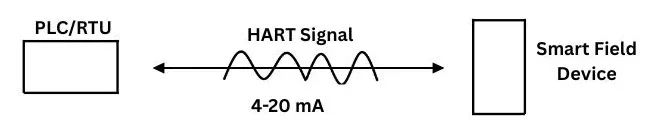
HART (Highway Addressable Remote Transducer) is an open standard protocol widely used in control and instrumentation. It provides digital communication over the analog 4-20 mA line. It adds additional digital information to the 4-20 mA signal using the Frequency Shift Keying (FSK) method.
HART provides half-duplex communication and transmits data at 1200 bits/second. The digital signal operates at frequencies of 1200 Hz and 2200 Hz; 1200 Hz represents bit "1", and 2200 Hz represents bit "0".
### Advantages and Applications of Systems
Each signal system is suitable for different applications and needs. With advancing technology, no single system offers absolute superiority over another, and plants typically use a mixture of various systems. The primary goal is to achieve high-performance control with reliable data acquisition and centralized control systems.