






Erkan Teskancan
Kurumsal
- Thread Author
- #1
## 5,000 fps Synchrotron Imaging with Allied Vision Camera
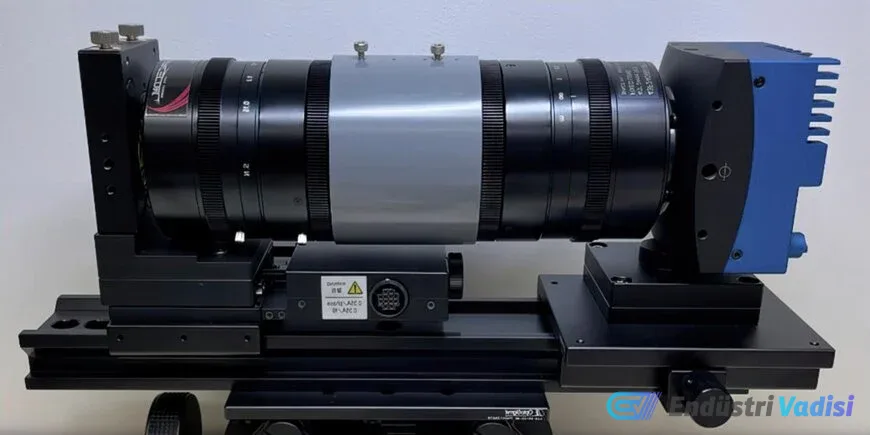
High-speed X-ray imaging technology is critical for real-time monitoring of structural and chemical changes in fields such as materials science, battery research, and food engineering. The "Hayaka" system, developed by Tohoku and Nishikyushu Universities, addresses this need based on Allied Vision's EoSens 1.1CXP2 CMOS camera.
Hayaka offers 4-dimensional (4D) computational tomography and X-ray absorption analysis, with exposure times at the microsecond level and speeds reaching 5,000 frames per second. The system can observe simultaneous structural and chemical processes.
### Fast Chemical and Structural Transitions with the Hayaka System
Dynamic observations are possible in areas such as material testing, battery electrode reactions, and food processing, where phase transitions occur in less than a second. The system provides 4D tomography of rapid transient processes with a minimum exposure time of 1 microsecond.
Thanks to the XAFS mode, full spectral image data can be obtained in half a second, enabling chemical state mapping in advanced battery and functional material research.
### Optical Architecture Providing High Photon Efficiency
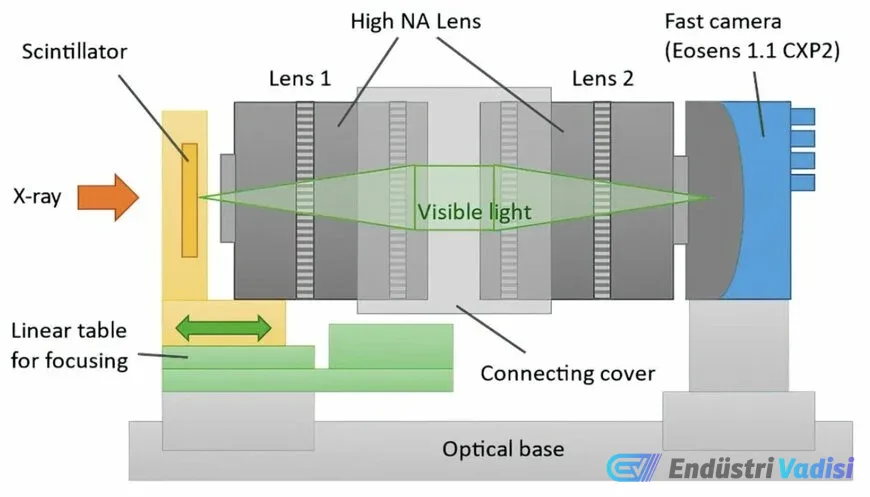
The system consists of a scintillator, a high-performance lens array, a CMOS camera, a precise focusing mechanism, and a rigid mounting base. While the scintillator converts X-ray photons into visible light, two high numerical aperture lenses are placed back-to-back to increase light collection efficiency. This ensures a strong signal even with microsecond exposures.
### Technical Specifications of the EoSens 1.1CXP2 CMOS Camera
- Global shutter sensor
- 1.1-megapixel resolution (1280 × 864 pixels)
- 13.7 µm pixel size
- 10-bit depth, recorded as 16-bit
- 3,660 fps at full resolution
- 5,000 fps at 800 × 400 pixels
- 50 Gbit/s data transfer rate with CoaXPress 2.0 interface
### High-Speed Data Transfer and Application Areas
Data is transferred at high speed via four-channel CoaXPress 2.0, ensuring continuous high frame rates. This is critical for data continuity in time-limited synchrotron experiments.
In a sample application, a spatial resolution of 77 µm was achieved with a 10-microsecond exposure using white and monochromatic beams. This allows for clear capture of fast-moving objects.
### 4D Imaging Experience in Dynamic Processes
The system recorded the boiling process of Japanese noodles over 150 seconds with a time resolution of 0.5 seconds during a cooking process using a high-speed rotary table. This demonstrates that 4D-CT can be applied to food science and process engineering beyond just material testing.
### Future Plans for Battery Research and Process Analysis
The research focuses on developing time-resolved chemical state mapping within battery electrodes, particularly during charging and relaxation processes. Synchronization with an aluminum double-crystal monochromator controlling energy selection is planned.
Additionally, "in coquendo" 4D-CT systems are being developed to monitor cooking processes such as boiling, baking, steaming, frying, and microwave heating in real time.
### Conclusion
With microsecond exposure, multi-gigabit data transfer, and optimized optical efficiency, the Hayaka system demonstrates the potential of next-generation high-speed CMOS imaging platforms for synchrotron experiments requiring spatial, temporal, and chemical resolution.