







Ahmet Ö.
Kurumsal
- Thread Author
- #1
## Closing the Missing Link in SIS Design: Addressing the Logic Solver Gap
Safety professionals in the industry need a new generation of logic solvers to fill the significant logic solver gap that exists in Safety Instrumented System (SIS) design.
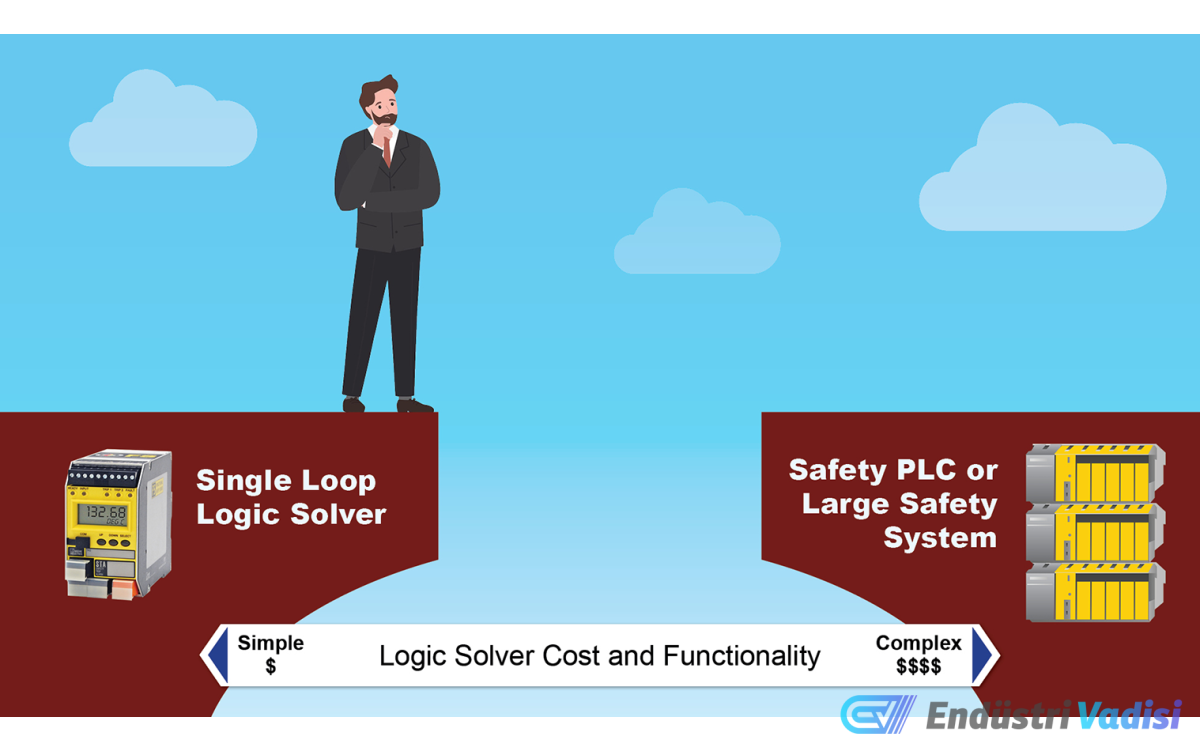
The logic solver, the decision-making core of every SIS, evaluates process inputs, applies voting logic, and initiates actions to mitigate risk. However, traditional choices often present engineers with two extreme options: a full-featured Safety PLC or a single-loop logic solver (alarm trip). These two methods were developed for different needs, and most modern SIS applications fall between these two options. This situation leads engineers to either choose overly complex single-loop devices or use expensive Safety PLCs. This situation is called the "logic solver gap" and costs the industry time, money, and unnecessary complexity.
### Limitations of Traditional Options
Single-loop logic solvers, i.e., alarm trip devices, have evolved to include diagnostics, password protection, user-friendly menus, and configurable logic features. They are quickly commissioned and easy to maintain. However, they are insufficient when multiple loops need to be monitored or when complex voting logic needs to be applied. They are not designed for multi-loop safety applications.
Safety PLCs, on the other hand, can manage small safety applications but have significant disadvantages such as high software licenses, specialized programming skills, additional documentation, and high lifecycle costs. For applications such as remote operations, temporary facilities, skid systems, or burner management units, they are often technologically unnecessary, economically expensive, or operationally inefficient.
### Application Realities Faced by Engineers
Many SIS designs include only a few safety functions. Common requirements:
- 1-3 independent safety loops
- Medium I/O count (typically 6-12 points)
- Simple voting logic, e.g., 1oo2 or 2oo3
- Local distribution to skids, packages, or remote units
- Simple testing and verification processes
### The Rise of the Multi-Loop Logic Solver
These mid-range solvers come to the forefront in applications where Safety PLCs are overkill: pump shutdown, burner management, wellhead safety, small-scale overpressure protection, tank protection, cleaning systems, and local trip systems. They are easy to integrate with existing BPCS or PLC infrastructures and play a complementary role between central systems and peripheral protection layers in hybrid safety strategies.
### Modular SIS Architectures and Local Safety
Across the oil, gas, chemical, and energy sectors, SIS structures are becoming more modular and decentralized. Instead of a central platform, local safety nodes for specific hazards or process units are becoming common. At this point, multi-loop logic solvers manage local voting and trip decisions, reducing wiring complexity, shortening commissioning time, and simplifying testing processes. They facilitate testing and re-verification processes according to the IEC 61511 standard.
### Integration to Maintain Independence
Modern multi-loop logic solvers have visualization and diagnostics features. Through communication protocols such as MODBUS, Ethernet diagnostics, or HART, safety status and device health are monitored with read-only access, thus not compromising safety independence. This is valuable for asset management, audit readiness, and maintenance planning, allowing central and local protections to work together in hybrid systems.
### Completing the Logic Solver Spectrum
Multi-loop logic solvers do not eliminate Safety PLCs or single-loop devices. They are solutions that complement logic solver options, offering a cost-effective and functional alternative for long-neglected mid-range applications. For those who want SIS designs that are easy to validate, practical to maintain, and more aligned with risk, the "missing link" is no longer a niche but is becoming a fundamental element of modern SIS architecture.
### Engineering Decision Matrix for Choosing the Right Logic Solver
Engineers should choose the correct solver type based on application complexity, number of safety loops, cost, and maintenance criteria. Multi-loop solvers are the ideal solution for small and medium-sized safety applications.