



- Thread Author
- #1
In addition to wireless sensors, two volt-free contacts can be connected to Pepperl+Fuchs' LoRaWAN sensor node. This strengthens long-range data transmission in existing control systems.
Pepperl+Fuchs has added volt-free contact connection capability to its WILSEN.node sensor. This feature offers the advantage of bringing Industrial Internet of Things (IIoT) functionality to existing devices, adapting them for modern data collection and process control. With this update, it is now possible to connect isolated, volt-free contacts such as switches and relays, which increases system flexibility while reducing electrical noise and enhancing safety.
Volt-free contact integration with WILSEN.node
WILSEN.node is Pepperl+Fuchs' LoRaWAN-based wireless sensor solution. Now, with the use of volt-free contacts with these sensors, the flexibility and safety of systems are increased.
What is a volt-free contact?
Volt-free (potential-free) contacts provide the connection between devices controlled without drawing power. These contacts manage controlled processes with electrical isolation; for example, relays or switches. A relay can connect to devices such as a pump controlling liquid level, thereby being isolated from other electronic components.
This isolation increases safety, protects hardware, and reduces electromagnetic interference. For example, impulse signals from switches can cause errors in sensors. With WILSEN.node, these risks are minimized.
For more information: Review and technical details
t on motors can also cause EMI that can bleed into instrumentation signals.
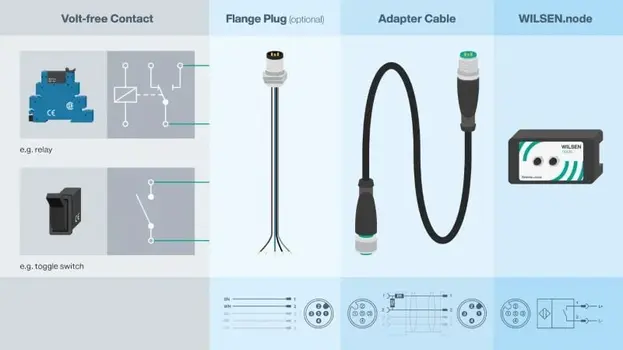
Volt-free contacts, such as relays and toggle switches, can be connected to the WILSEN.node with the use of an adapter cable
Volt-free contacts, such as relays and toggle switches, can be connected to the WILSEN.node with the use of an adapter cable. Image used courtesy of Pepperl+Fuchs
Volt-free contacts, such as relays and toggle switches, can be connected to the WILSEN.node with the use of an adapter cable. Image used courtesy of Pepperl+Fuchs
LoRaWAN WILSEN.node Upgraded
Pepperl+Fuchs’ WILSEN.node LoRaWAN-based wireless sensor node already allows systems engineers to interface inductive and capacitive sensors, such as level sensors, leak detection connections, rotational speed output from motors, flow sensors, and other such devices. Sensors are connected wirelessly via LoRaWAN. By adding volt-free connections, users can save on wiring and headaches for retrofitting machines safely.
Volt-free contacts can be connected to the WILSEN.node via a resistor network and adaptor cable. This allows switches and relays to be up to 10 m away from the WILSEN.node. The cable can also be routed through the housing for a clean, compact installation.
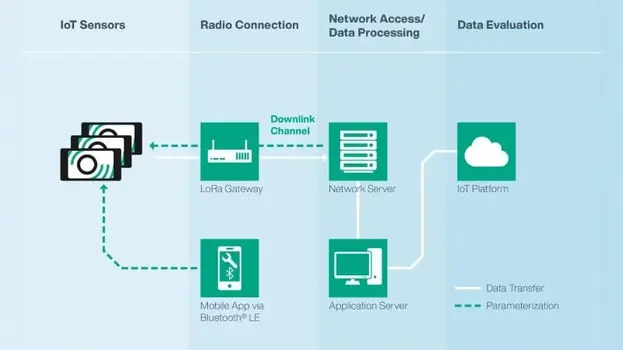
The WILSEN.node utilizes a LoRaWAN network to enable signal transmission over long distances, bringing IoT capabilities to existing systems
The WILSEN.node utilizes a LoRaWAN network to enable signal transmission over long distances, bringing IoT capabilities to existing systems. Image used courtesy of Pepperl+Fuchs
The WILSEN.node utilizes a LoRaWAN network to enable signal transmission over long distances, bringing IoT capabilities to existing systems. Image used courtesy of Pepperl+Fuchs
Retrofitting Control Systems
While many control systems benefit from the additional flexibility provided by
volt-free contacts, Pepperl+Fuchs explicitly highlights several industrial examples. The WILSEN.node is already designed for retrofitting applications, and the new connections make it a good fit for machine monitoring, such as for tallying operation hours.
In terms of specific industries, Pepperl+Fuchs envisions this equipment being used extensively in the chemical process industries. They suggest integrating the newest WILSEN.node with pumps, level controllers, and leak detection sensors. It can also monitor HVAC controls, such as moving dampers and shutters, blower motor controls, vent position, and other hardware. Also, dock monitoring and control, like closing and locking bay doors, detecting trucks, and other such tasks, can be integrated with the updated WILSEN.node.
Pepperl+Fuchs has added volt-free contact connection capability to its WILSEN.node sensor. This feature offers the advantage of bringing Industrial Internet of Things (IIoT) functionality to existing devices, adapting them for modern data collection and process control. With this update, it is now possible to connect isolated, volt-free contacts such as switches and relays, which increases system flexibility while reducing electrical noise and enhancing safety.
Volt-free contact integration with WILSEN.node
WILSEN.node is Pepperl+Fuchs' LoRaWAN-based wireless sensor solution. Now, with the use of volt-free contacts with these sensors, the flexibility and safety of systems are increased.
What is a volt-free contact?
Volt-free (potential-free) contacts provide the connection between devices controlled without drawing power. These contacts manage controlled processes with electrical isolation; for example, relays or switches. A relay can connect to devices such as a pump controlling liquid level, thereby being isolated from other electronic components.
This isolation increases safety, protects hardware, and reduces electromagnetic interference. For example, impulse signals from switches can cause errors in sensors. With WILSEN.node, these risks are minimized.
For more information: Review and technical details
t on motors can also cause EMI that can bleed into instrumentation signals.
Volt-free contacts, such as relays and toggle switches, can be connected to the WILSEN.node with the use of an adapter cable
Volt-free contacts, such as relays and toggle switches, can be connected to the WILSEN.node with the use of an adapter cable. Image used courtesy of Pepperl+Fuchs
Volt-free contacts, such as relays and toggle switches, can be connected to the WILSEN.node with the use of an adapter cable. Image used courtesy of Pepperl+Fuchs
LoRaWAN WILSEN.node Upgraded
Pepperl+Fuchs’ WILSEN.node LoRaWAN-based wireless sensor node already allows systems engineers to interface inductive and capacitive sensors, such as level sensors, leak detection connections, rotational speed output from motors, flow sensors, and other such devices. Sensors are connected wirelessly via LoRaWAN. By adding volt-free connections, users can save on wiring and headaches for retrofitting machines safely.
Volt-free contacts can be connected to the WILSEN.node via a resistor network and adaptor cable. This allows switches and relays to be up to 10 m away from the WILSEN.node. The cable can also be routed through the housing for a clean, compact installation.
The WILSEN.node utilizes a LoRaWAN network to enable signal transmission over long distances, bringing IoT capabilities to existing systems
The WILSEN.node utilizes a LoRaWAN network to enable signal transmission over long distances, bringing IoT capabilities to existing systems. Image used courtesy of Pepperl+Fuchs
The WILSEN.node utilizes a LoRaWAN network to enable signal transmission over long distances, bringing IoT capabilities to existing systems. Image used courtesy of Pepperl+Fuchs
Retrofitting Control Systems
While many control systems benefit from the additional flexibility provided by
volt-free contacts, Pepperl+Fuchs explicitly highlights several industrial examples. The WILSEN.node is already designed for retrofitting applications, and the new connections make it a good fit for machine monitoring, such as for tallying operation hours.
In terms of specific industries, Pepperl+Fuchs envisions this equipment being used extensively in the chemical process industries. They suggest integrating the newest WILSEN.node with pumps, level controllers, and leak detection sensors. It can also monitor HVAC controls, such as moving dampers and shutters, blower motor controls, vent position, and other hardware. Also, dock monitoring and control, like closing and locking bay doors, detecting trucks, and other such tasks, can be integrated with the updated WILSEN.node.