Erkan Teskancan
Kurumsal
- Thread Author
- #1
## Industrial Connectivity and DataOps: Working Together to Unlock Your Production Data
Processing production data is a complex process. Collecting, processing, and transforming data for the benefit of operations and the company requires a solid understanding.
Production data is locked within different machines. Countless devices like PLCs, CNC machines, and temperature sensors use their own protocols. Extracting this data, making sense of it, and improving operations is one of the biggest challenges in today's manufacturing.
This article discusses two types of industrial software that solve this problem: connectivity platforms like Kepware collect data from machines; DataOps platforms like HighByte process the data and prepare it for business use.
### Challenges Faced on the Factory Floor
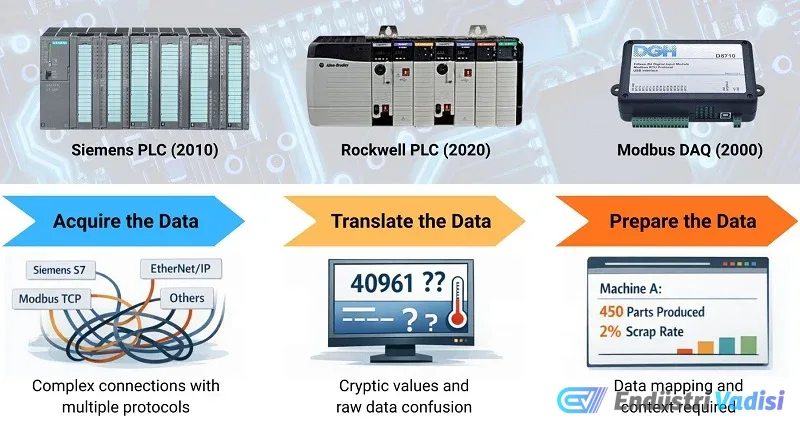
A factory contains equipment from different manufacturers. A Siemens PLC manufactured in 2010, an Allen-Bradley controller from 2018, and older Modbus-connected machines from 2005 work side-by-side. These devices use different protocols and data formats.
Engineers face three main challenges when using production data:
- Different technical knowledge is required to connect to each machine (Siemens S7, Allen-Bradley Ethernet/IP, Modbus TCP, etc.). A single line may require 5-10 different protocols.
- Raw data has no meaning; for example, a temperature sensor reports a number like "40961," and the meaning of this value is unknown.
- Business systems (dashboards, analytics tools) expect organized and contextualized data; not "Register 1045 = 450," but "Machine A produced 450 parts with a 2% scrap rate."
### Collaboration of Industrial Connectivity and DataOps
To best solve the problem, two specialized platforms are used together:
- Connectivity platforms collect data from all machines and convert it into a standard form; this acts as a kind of translation.
- DataOps platforms then add meaning to this standard data, enrich it with business context, and prepare it for analysis, dashboards, or artificial intelligence systems.
### Comparison of Kepware and HighByte Platforms
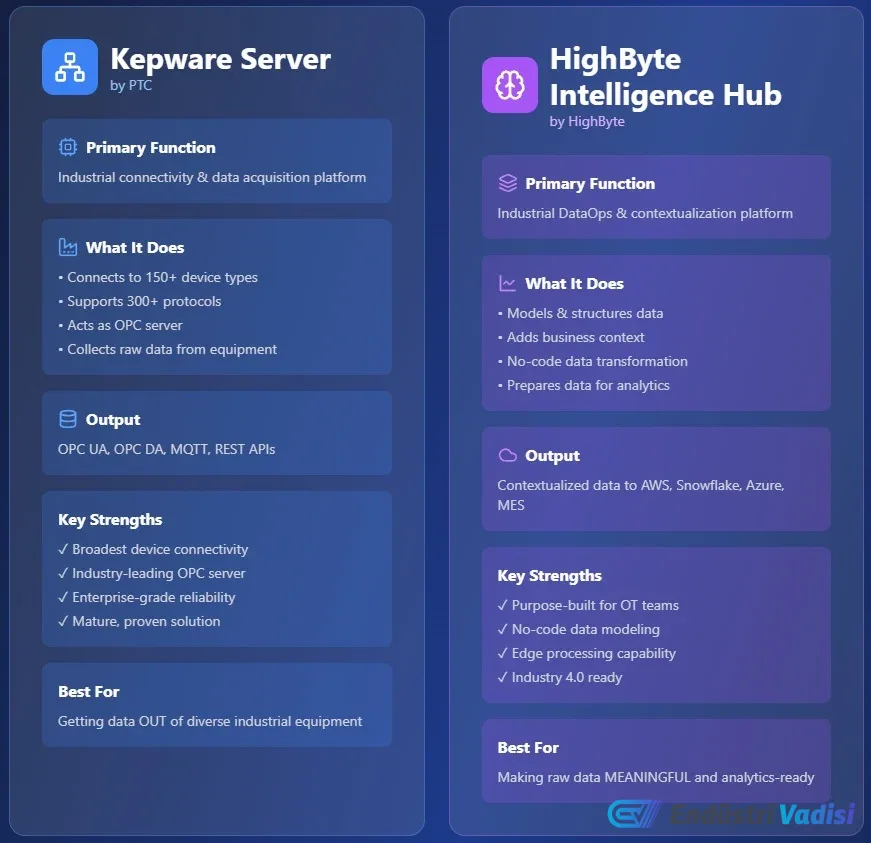
Kepware:
- Connects different machines without programming, with over 150 pre-built drivers.
- Provides a cloud-based central control panel for multi-factory management.
- Converts all protocols to standards like OPC UA and MQTT.
HighByte:
- Creates reusable data templates for similar equipment.
- Enriches technical data with business context (e.g., production line, product code, time information).
- Performs calculations at the edge to optimize data (OEE, production count, downtime).
- Ensures data quality and management; performs validation and version tracking.
### Real-Life Scenario: Packaging Line Quality Monitoring
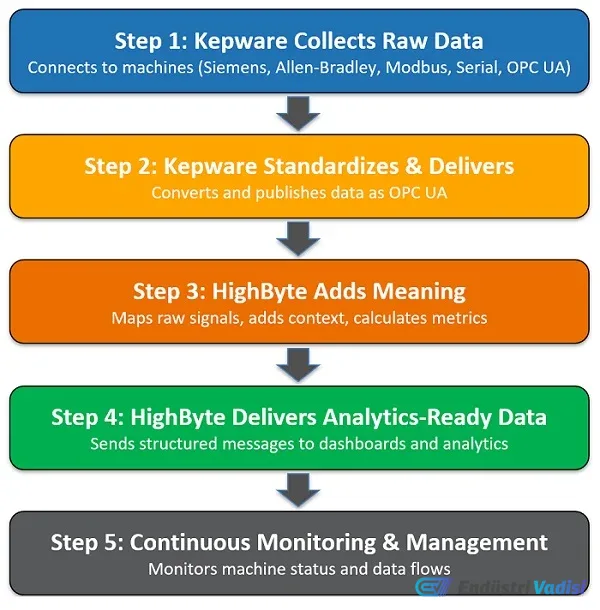
Kepware collects data from Siemens PLCs, Allen-Bradley PLCs, Modbus devices, a custom-protocol weighing device, and an OPC UA-enabled visual inspection system. All data is shared over the network in OPC UA format.
HighByte processes this data with a production line model; it combines, contextualizes, and analyzes filling, capping, labeling, and quality control data. It provides summarized, meaningful reports instead of raw data (e.g., product count, scrap rate, and line information).
### Why Two Systems?
Kepware solves the challenging connectivity problem, while HighByte focuses on making the data valuable. This specialization allows for the best solutions for both tasks and provides scalability.
### Implementation Phases
- Phase 1 (1-2 months): Pilot implementation on a single production line
- Phase 2 (2-3 months): Plant-wide rollout
- Phase 3 (3-6 months): Expansion to other facilities
- Phase 4 (ongoing): Integration of advanced capabilities
### Conclusion
Production data becomes a valuable asset that supports decisions. Managing connectivity and data organization with specialized separate platforms simplifies processes, transforms data into business insights, and scales with the growth of the business.
Data ceases to be a technical problem; it becomes a critical resource supporting operational improvement.