





Cengiz Özemli
Akademisyen
- Thread Author
- #1

In industrial motor drives, the DC bus circuit is a significant source of failures experienced during power-up of VFDs and servo drives. This article explains precharge circuits, inrush current, and the causes of power-up problems with a simple, technician-friendly approach.
When a VFD or servo drive fails to start immediately upon power application or continuously trips, it often indicates problems in the front-end of the drive rather than the motor. These issues are typically related to the rectifier, the DC link (DC bus), or the precharge circuit, which ensures controlled charging of the bus capacitors.
### The DC Bus and Its Importance
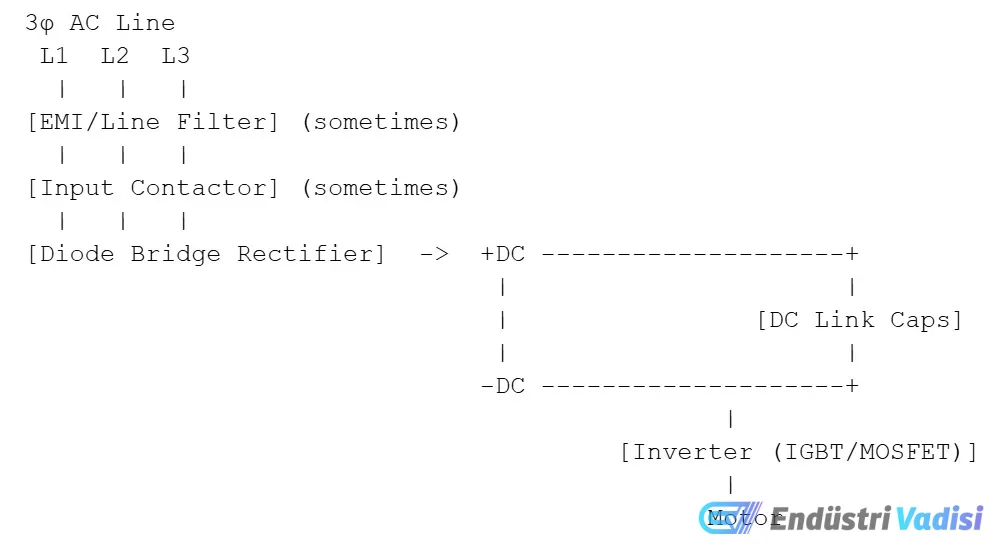
The rectifier converts incoming AC voltage to DC. The DC link capacitors then transform this DC voltage into a stable source for the inverter. Especially in many 480 VAC three-phase drives, a healthy and charged DC bus voltage typically ranges between 650–680 VDC.
### Startup Problems and Inrush Current
At startup, the DC link capacitors are discharged and initially behave like a short circuit. The rectifier immediately attempts to charge the capacitor bank, limited only by the system impedance. The resulting high inrush current can blow input fuses, trip circuit breakers, and damage components.
Texas Instruments provides an important engineering explanation on inrush current limiting related to this topic.
### Precharge Circuit and Operating Principle
During normal startup, the bus voltage gradually rises in a controlled manner through a precharge resistor, taking anywhere from a fraction of a second to several seconds. Once the predetermined voltage level is reached, a bypass contactor engages, usually accompanied by an audible click. If the bypass fails to engage, the bus voltage may remain partial or rise too slowly, leading to a timeout.
### Key Components and Failure Symptoms
- Rectifier (diode bridge): A short-circuited diode or bridge causes fuses to blow. Open or weak diodes may allow the control unit to power up, but the bus voltage will not reach the expected level.
- DC link capacitors: While sudden short circuits cause major failures, over time, increased ESR (equivalent series resistance) and decreased capacitance lead to low voltage, unstable supply, or timeout issues.
- Precharge resistor and bypass relay: An open precharge resistor or a bypass relay that fails to pull in causes problems like getting stuck in charging or startup errors.
### Failure Analysis and Safety
Immediate trips at startup usually indicate a hard short circuit in the front end. Precharge path issues manifest as pauses in voltage rise or failure of the bypass to engage. Additionally, missing phases in the power supply, imbalance, or long lines can lead to undervoltage problems.
High voltage, common DC bus systems, and regenerative interactions are rare but possible causes of failure.
For safety reasons, DC bus components can carry high voltage even after power is disconnected, which can be lethal. Therefore, it is crucial to implement proper lockout/tagout procedures, verify the absence of voltage, and use appropriate measuring instruments.
### Troubleshooting Recommendations
- Check supply voltages (L1-L2, L2-L3, L1-L3).
- Observe the voltage increase during the DC bus charge window.
- If there is a sudden drop or constant voltage, investigate component failures or precharge problems.
- Perform resistance measurements to analyze open or short circuits.
In summary, the DC bus is fundamentally a predictable energy storage, and with proper maintenance, drive power-up issues can be significantly reduced. Failures typically stem from hard short circuits, inadequate precharge, sensing problems, or low supply voltage.