




Endüstri Vadisi
Endüstri Vadisi
- Thread Author
- #1
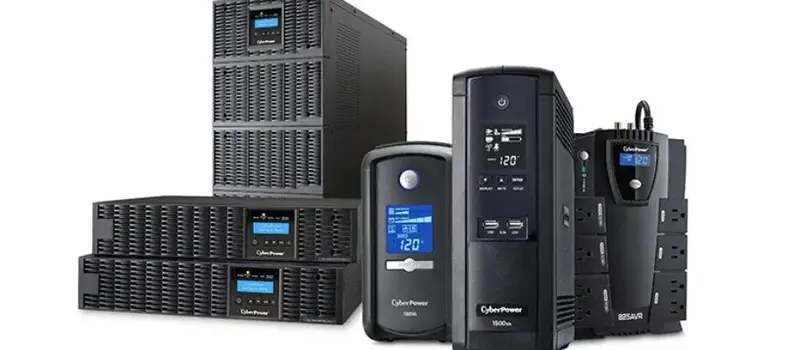
While they serve the same purpose, they accomplish it in different ways. Both solutions have different advantages and disadvantages, depending on an organization’s short- and long-term needs. For high-visibility and high-consumption sectors, such as transportation, public/government, IT, and financial services industries, where power supports vital applications associated with an acute sense of internal and external urgency, ensuring continuous and adequate power is of paramount importance.
In the following sections, we will discuss the ways in which centralized and distributed UPSs provide the flexibility companies need to scale their power protection in alignment with their current needs and future growth.
Distributed UPS
Distributed UPSs are mounted directly in or next to the server rack, so that (potentially) every server has UPS hardware connected to it with almost no space between the hardware and servers. A distributed UPS can be likened to flashlights illuminating every 4.5 meters of a space, whereas a centralized UPS can be likened to a giant floodlight casting light in a 30-meter radius. If one of the distributed UPS’s flashlights goes out, it only darkens the 4.5-meter area around it; if the centralized UPS’s floodlight temporarily goes out, everything metaphorically goes dark.
Reliability: Power in Proximity
In a business’s IT network and electrical grid, the greater the distance between the server and its associated UPS, the greater the risk of power issues, such as noise, grounding, and/or loose connections. Since distributed UPSs are mounted in or adjacent to server racks, the distance between them is shortened, significantly reducing the likelihood of faulty wiring along the power chain. By providing independent auxiliary power throughout the network, mass power outages that can occur when using a centralized UPS are avoided.
Ease of Installation and Integration
Due to their lighter weight and greater portability, distributed UPSs are much easier to install and move around, making them ideal for companies that need greater mobility in their data centers. Proximity to server racks also optimizes the location of distributed UPSs to Ethernet connections.
Better Cost Control for Smaller Organizations
Since distributed UPSs are designed to support a single server rack within a network, rather than an entire business’s network, the initial cost of purchasing this solution is significantly lower than that of centralized UPSs, which are often overkill for small and medium-sized businesses (SMBs). Compact UPSs have the same lifespan as server hardware, which allows organizations to economically synchronize their server hardware and redundant UPS upgrades. When smaller companies need to expand their backup power protection, they can choose to increase the redundancy of their system by adding additional UPSs as needed, at a much lower cost compared to a centralized UPS.
Disadvantages: Inefficient Management
- The role of servers puts them ahead of power backup systems, which makes the space occupied by UPSs in server racks (and kept away from servers) less than ideal.
- Distributed UPSs, by their very design, are more efficient than centralized UPSs, requiring a much larger network of resources to manage and monitor compared to a centralized UPS. Therefore, their management can sometimes be a burden for an organization's IT or data center staff.
Centralized UPS
As the name implies, centralized backup infrastructure consists of one or two large UPSs located around the perimeter of a server room, at the end of a server row, or in a nearby standalone location. Centralized UPSs are like a giant power protection network covering an entire organization's network.
Reliability
For larger companies, the single-phase power protection common in smaller, decentralized UPSs would be insufficient to meet their power protection needs. Centralized UPSs are designed with high-density server hardware needs in mind. Since these typically operate on three-phase power, more powerful UPSs that can provide protection for both three-phase and single-phase loads are an appropriate choice. Servers now operate at much higher speeds than in previous eras, but higher temperatures can significantly shorten the life of UPS batteries. The remote location of centralized UPSs protects their batteries, extending their lifespan and reducing time-consuming and costly early battery replacements.
Stable Output and Better Use of White Space
Centralized UPSs typically operate with an online, double-conversion architecture, which provides greater stability in the power curve and eliminates most power disturbances (i.e., surges, sags, swells). Distributed UPSs, on the other hand, are designed to react to power disturbances (via line-interactive architecture), which means that anomalies can be transmitted to end devices. Additionally, in a centralized backup architecture, UPSs are kept separate from server racks, providing critical space for server hardware.
Improved Economies of Scale
To increase capacity with a distributed backup architecture, data support personnel must manually add additional UPSs to each server rack, which is a tedious and inefficient process for large organizations. In addition to reducing critical server rack space that could be used for server hardware, this doubles the number of equipment data technicians have to monitor and maintain, challenging them. Creating redundancy with centralized UPSs is a one-step process, which takes significantly less time.
Disadvantages: Energy Inefficiency and Cost
The implementation of centralized UPSs occupies a much larger space and requires significantly more coordination for planning, installation, adjustment, testing, and commissioning. Companies often tend to "bite off more than they can chew" when choosing and implementing centralized UPSs. Because organizations overestimate how much capacity they need from their centralized UPSs, up to 25% of the energy they consume is wasted. The excess energy generated in this common scenario manifests as excessive heat, which increases the demand on cooling systems in data centers, leading to higher energy costs. It is not uncommon for these UPSs to require a dedicated HVAC system to manage the additional energy output.
In addition to the added costs created by the increased demand for data center cooling, the price of centralized UPSs tends to be significantly higher than their lighter, distributed counterparts.
Hybrid Solutions
Modular UPSs can create a more robust backup architecture for many critical operations in medium-sized data centers. With modular UPSs, organizations can increase backup system redundancy by installing additional power modules when needed, thus providing the efficiency of a centralized backup system and the gradual growth (and costs) of a distributed system. At full capacity, the three-phase Modulon DPH Series offers the highest possible availability:
- 25kW to 75/150/200kW of continuous power and an additional 800kW capacity in parallel
- Mean time to repair (MTTR) is close to zero
- Integrates with existing power distribution in a parallel rack or the same rack
- Self-synchronization of power and control modules supports continuous online operation even if the control module fails
- High overload protection – 125% overload for 10 minutes and 150% overload for one minute
- Expands up to four units without needing additional hardware
- Built-in manual bypass eliminates maintenance-related outages
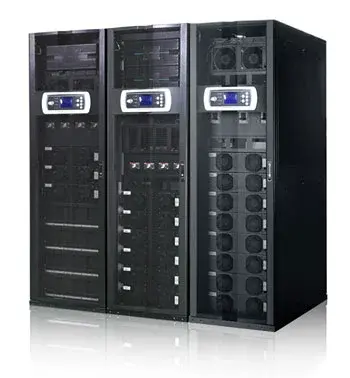
Alternatively, a hybrid backup architecture that incorporates both centralized and distributed UPSs can offer a solution that covers more ground and compensates for the weaknesses of one system with the strengths of the other.Conclusion and Summary
As the preceding discussion has shown, determining which backup solution is best will depend on a complex matrix of variables, such as your organization's ability to monitor or manage a particular backup system, the cost-benefit ratio of both solutions, existing server rack utilization capacity and future needs, current and projected power demands, and more technical questions like whether your server uses single-phase or three-phase power. Additionally, both options have advantages and disadvantages, but by fully evaluating each UPS solution and your organization's needs, managers can better determine which of these strategies is best.
| Distributed UPS | Centralized UPS | |
| Reliability | Power in proximity | 3-phase power with more stable output |
| Ease of Installation | Better (lightweight) | Worse (heavier weight) |
| Cost and Efficiency | Better cost control for small organizations | Improved economies of scale |
| Space | UPS occupies space for servers | Larger footprint but better use of white space |
| Management | Inefficient management | Centralized management in the power room is easier |