



Erkan Teskancan
Kurumsal
- Thread Author
- #1
## The Transformation Brought by Bringing Your Own AI Assistant to Industrial Automation
AI-powered automation has long been seen as specialized assistants or chatbots offered by vendors. However, this approach is rapidly changing; AI is now becoming a resource that businesses bring themselves.
Large Language Models (LLMs) are not, in a philosophical sense, true "intelligence"; they are computational power. LLMs are merely sophisticated silicon arrangements that enable data processing, and calling them "intelligent" is as meaningful as asking whether computer chips are "intelligent."
### AI and Computational Power
When LLMs are viewed as computational tools, software is not purchased dependent on a specific processor. Similarly, ERP systems are used independently of the electricity provider. Here, processing power is a component that the customer brings from their own infrastructure — local, cloud, or via existing systems.
In this scenario, plant operators will use accessible AI just as they currently use smartphones or email. Furthermore, without being dependent on a single vendor's AI application, automation systems will provide well-structured data that any AI, such as Claude, ChatGPT, or future tools, can utilize.
### Feeding Data is Priority
The real question now becomes, "What data should I feed my AI agent?"
### Three Fundamental Paths
Today, most AI solutions operate with each application containing its own built-in agent. This is simple but limiting; such an agent can only access information known to the vendor, lacking access to maintenance records, ERP data, or actual production KPIs.
- Built-in agents: Systems currently available, but limited to working within a single software.
- API-based interactions: Flexible but data-structure-complex models that allow your own AI agent to communicate with everything.
- Hybrid model: Systems where your agent communicates with vendor systems, and vendor systems use internal agents optimized for consumption by AI.
This third approach is the rapidly adopted model that makes the concept of "feeding your agent" meaningful.
### Data is More Important Than AI Features
AI agents are only as useful as the quality of the data they are fed. Poor results can be obtained with unstructured and complex data, but with accurate and meaningful data, true AI value is unleashed.
Industrial automation involves time-sensitive, dense telemetry such as PLC signals, error codes, cycle times, sensor behaviors, video streams, and HMI interactions.
Today's remote monitoring tools record the data that AI agents need, such as cycle anomalies, sensor vibrations, downtime, error logic, and environmental irregularities.
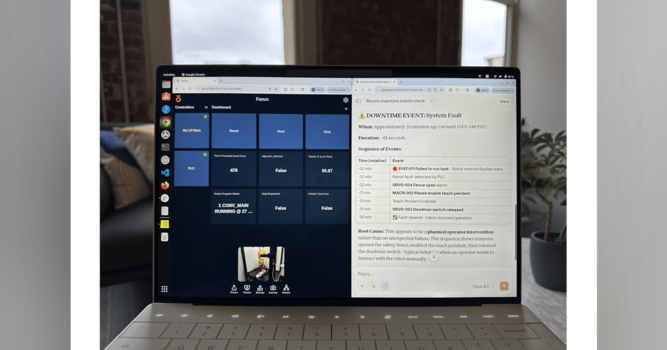
### Technical Specifications: Olis Robotics Remote Monitoring Software
- Structures data such as PLC signals, error codes, cycle times, and video feeds
- Presents data with semantic framework and contextual cues
- Organizes data for AI comprehension
Such systems can be used in automation processes like adding or removing buttons on an HMI with voice commands. The AI agent also performs tasks autonomously when fed with the correct data.
### Remote Monitoring and AI Feeding
Instead of transmitting raw data to an expert or an engineer via VPN access, you can direct your own Large Language Model (LLM) directly to the relevant data. The AI agent detects anomalies, suggests possible causes, and cross-checks with internal KPIs or business objectives.
### More Control for Manufacturers
The biggest advantage of bringing your own AI agent is that it gives control back to industrial users. Users can choose the LLM they want, control the depth and cost of analysis, and are not tied to vendor AI roadmaps.
As AI is controlled as an input, automation systems can be integrated with ERP, combining operational data with business context; thereby reducing risks associated with delivering data to third parties.
### Summary
- AI is not a purchased product, but your software that can process data.
- AI agents are not your factory's brain, but the computational power you bring.
- Systems that feed clean, structured, and meaningful data should be preferred.
- Thus, any vendor's LLM diagnoses devices, generates reports, and integrates into your digital ecosystem.
This new approach is a significant milestone in the digital transformation of industrial automation, enabling users to collaborate more effectively with artificial intelligence.