






- Thread Author
- #1
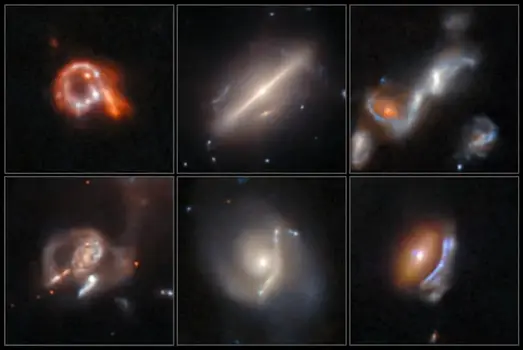
Researchers detected over 1,300 unusual celestial objects by analyzing approximately 100 million images with artificial intelligence in just two and a half days.
A team of astronomers used a new AI-powered method to sift through the vast archive of NASA's veteran Hubble Space Telescope.
Researchers detected over 1,300 unusual celestial objects by analyzing approximately 100 million images in just two and a half days. It was noted that more than 800 of these objects had never been documented in scientific literature before.
Rare cosmic structures such as colliding galaxies, gravitational lenses, and ring galaxies are of great importance in astronomy. However, finding such objects within the ever-growing piles of data produced by instruments like the Hubble Space Telescope is like looking for a needle in a haystack.
MONTHS, YEARS OF SCANNING
David O’Ryan and Pablo Gómez from the European Space Agency (ESA) developed an AI-based tool to solve this problem.
The researchers tested this tool, which can perform a scan that would take months or years for the human eye, on the Hubble Legacy Archive. The archive contains tens of thousands of datasets collected over Hubble's more than 35 years of mission.
Lead author of the study, David O’Ryan, stated in the article published in Astronomy & Astrophysics journal:
“Hubble Space Telescope’s archival observations span 35 years and contain a real treasure trove where astrophysical anomalies can be found.”
INSPIRED BY THE HUMAN BRAIN
At this point, the researchers developed a neural network they named AnomalyMatch. This AI system, inspired by the human brain, was trained to recognize rare cosmic objects.
AnomalyMatch scanned approximately 100 million small image fragments in the archive. This marks the first time the Hubble archive has been systematically examined for astrophysical anomalies. The scan was completed in just two and a half days, and a list of potential anomalies was generated.
OVER 800 COMPLETELY NEW TO THE SCIENTIFIC WORLD
In the final stage, the sources flagged as most unusual by the artificial intelligence were personally examined by the researchers. As a result of the examination, over 1,300 genuine anomalies were confirmed; more than 800 of these are completely new to the scientific world.
The majority of the discovered anomalies consist of galaxies in the process of merging or interacting. These galaxies take on unusual shapes and carry long tails of stars and gas.
Another important group is gravitational lenses: the gravity of a foreground galaxy bends light from a distant background galaxy, creating ring or arc-shaped images.
The team also found many rare examples such as galaxies with giant star clusters, galaxies with gaseous "tentacles," and planet-forming disks that resemble hamburgers or butterflies when viewed edge-on. The most striking discoveries were dozens of completely mysterious objects that did not fit into any existing category.