








Erkan Teskancan
Kurumsal
- Thread Author
- #1
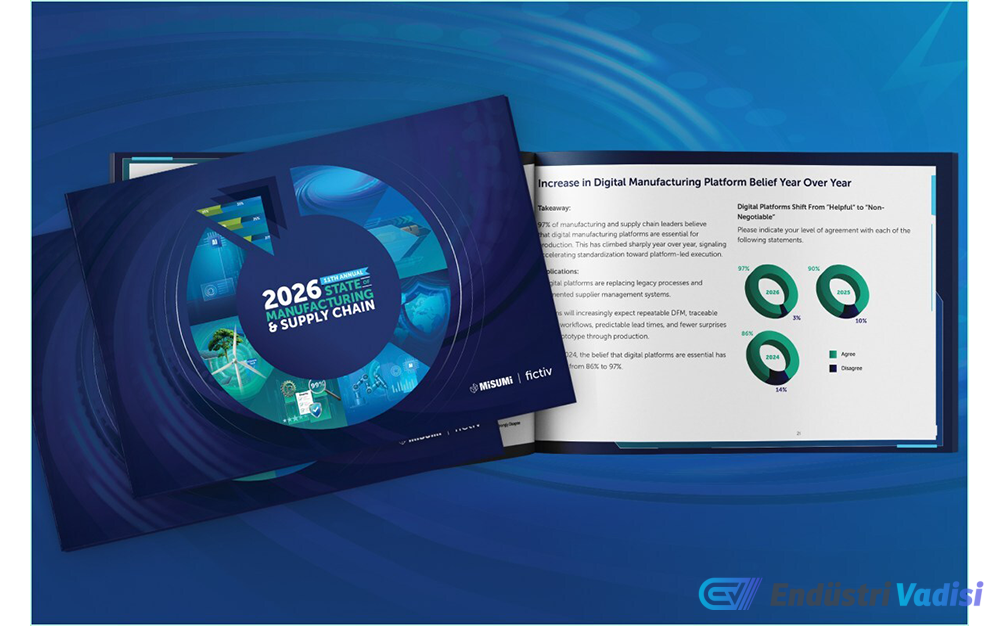
## AI and Digital Platforms Accelerate Transformation in Manufacturing and Supply Chain
Fictiv's 2026 State of Manufacturing and Supply Chain Report reveals that the constantly changing environment in the industry is creating radical transformations at all stages, from product design to the manufacturing process.
### New Leadership Model and Industrial Challenges
The global manufacturing sector has entered a new era where quality, compliance, and transparency have become imperative. Ryusei Ono, Representative Director of MISUMI Global, emphasizes that the expectation for quality and consistent performance is increasing among their customers in an environment of growing regional, regulatory, and technological complexity.
The 2026 report indicates that artificial intelligence (AI), digital platforms, and localization approaches form the foundation of competitiveness in the sector.
### Research Highlights
- 95% of respondents believe that the application of AI in manufacturing and supply chains is critical for the future of companies.
- 95% believe that AI and automation help close the labor gap but cannot replace jobs requiring expertise.
- 97% state that digital manufacturing platforms are indispensable in production.
- 93% state that reshoring manufacturing to the US is a priority.
- 81% believe that supplier sourcing and management are time-consuming and costly.
- 77% state that trade compliance requirements are too complex to manage without external expertise.
### AI and Digitalization Strategies
Dave Evans, CEO of MISUMI Americas, states that speed, predictability, and resilience determine today's competitive advantage, and companies that achieve these advantages actively use artificial intelligence and digital platforms.
A survey involving over 300 senior leaders shows that increases in raw material costs are effective in developing smarter and more resilient supply strategies. Additionally, 83% of engineers spend more than four hours a week on procurement processes, and 93% of leaders see increased efficiency with reduced workload.
### Importance of Digital Transformation in Manufacturing
As the complexity of manufacturing processes increases, so do the challenges in supply chain management. Production planning stands out as the biggest challenge in balancing cost, quality, and time-to-market. Supplier management is noted as requiring more time and cost compared to last year.
AI applications have moved beyond the experimental stage to active use; 97% of participants stated that AI is central to manufacturing and supply chain processes, and 95% considered AI essential. Efficiency gains of 50% or more are expected with AI.
### About the 11th Annual State of Manufacturing and Supply Chain Report
This report was prepared in collaboration with DIMENSIONAL Research and covers over 300 executives and experts working in manufacturing, supply chain, R&D, and digital innovation. The majority of participants operate in the clean energy, electric vehicles, robotics, and medical technology sectors.
### About Fictiv and MISUMI
Fictiv removes the barriers of cost, complexity, and risk in global manufacturing through its production centers in India, Mexico, China, and the US. To date, it has produced over 39 million prototypes and commercial parts.
MISUMI Americas provides mechanical components and manufacturing solutions used in automation, robotics, medical, automotive, and other industries. By merging with Fictiv, it combines design, engineering, and manufacturing on a digital platform.